Showing posts with label skin. Show all posts

Tuesday, July 22, 2014

The Road Less Travelled--spelled with 2 'l's because it's still correct, Ms. Searcy who marked off for that when I memorized that dumb poem in 9th grade (I hold grudges to the GRAVE.)

Hyena tracks
I was trying to figure out what it is about traveling anywhere, near or far, in South Sudan that pretty much guarantees a good story. Is it the potential for seeing interesting animals? We have a lot of squirrels here and as someone who grew up in a squirrel-less country, I think they’re cool. We also followed hyena footprints a couple of times, but I still haven’t seen one for sure yet. But I don't think it's the animals. Is it the possibility of being in a vehicle that breaks down in the middle of the jungle? Maybe, but that happens so much it’s less memorable. I think it’s the thrill of the road conditions-slippery-sandy and dusty in the dry season, and sticky-slippy muddy in the rainy season. If you are on a motorcycle, you will fall over lots of time. I am going to blame the road and not Repent, even though he does love to look around for people he knows so that he can wave at them, occasionally failing to notice a pot-hole. We’ve yet to fall over because of that, though. Usually it’s because the front tire gets stuck in the mud and the back tire keeps trying to go forward and it’s not as easy as you think to pop a wheelie on a motorcycle with two people balancing on the brink of a pot-hole the size of a bathtub in a fancy hotel.  


Scratched-up legs
Our record of falls in one trip is 4 (or maybe 5?). The first two falls happened in real-life slow motion, giving me enough time to fling myself ungracefully off the back of the bike, stumbling to my feet without landing on my face in the mud.  The third time trying to do that, my boot got caught on the kick-stand and I ended up hanging there while Repent tried to pull the bike back up and I screamed at him to wait a minute before I did fall on my face in the mud. But the time that I burnt my leg on the knalpot (isn’t that such a better word that ‘muffler’?) was when I was squatting down digging mud out of the front tire guard (is that what the metal thing over the wheel that keeps it attached to the bike is called? It is now.) with my bare hands and a stick I found on the ground. It took about 20 minutes to get enough mud out so that the wheel would turn again. The fourth time we fell, Repent said, “Well, we’re here!” And I said, “Yup. This looks like a good place for a hand-pump. Let’s GPS.” And we really were basically at our destination, but since we still had to turn around and go back, we weren’t so crazy about perfect accuracy at this point. Especially since the drillers just need to get in the basic vicinity and choose the specific location later. 

After an hour of digging
 Even in cars, one is not safe from the perils of the road. We borrowed a car from a friend to go out to a village that was a bit farther away than we wanted to travel by bike. Just as we finished our work and were turning around to go home, torrential rains began to pour out of the sky. We decided that dropping off the village leader at his nearby home would be the kind thing to do, since he and several friends had come with us to show us the exact preferred hand pump location of the community. As we turned down the lane into his home, we sank down in the mud and stuck. The driver helpfully spun the wheels several times, trying to force our way out, but as I learned that time I got stuck in the snow in Philly, that doesn’t actually work and it might actually make things worse. Our passengers immediately jumped out of the car, completely defeating the purpose of driving them to their homes so that they wouldn’t get wet, grabbed their shovels and began to dig us out. It cost us 2 hours and it cost them 2 fully-grown cornstalks. Eventually, after digging a hole nearly half the size of the Grand Canyon and stuffing rocks and tree trunks under the back wheels, with the help of all the men pushing from the back and a burst of Earth-polluting black smoke from over-worked tires, we got out. And I would like to mention, that it only took me one extra-helpful young mailman to get me out of my snow bank. Clearly snow is not as powerful as mud.

Push!
 My most recent road-trip was much longer and also one that I’m not sure is worth the story I got out of it. Traveling from Mundri to Juba by car is never a luxurious experience, but it does not have to be physically painful—it usually is, but it does not have to be. This time I was hopeful that it wouldn’t be, but I hadn’t even left Parking (which is what bus stations are called here—maybe because all the broken down busses are parked there waiting to be fixed never?) before I realized that was not going to be the case. I squished into my corner by the window (permanently closed one, sadly), and then the bus owner came over to insist that I pay for my bag. He said, “This isn’t an airplane! You have to pay!” I didn’t want to feed his idea that one must pay for one’s bag, so I didn’t point out the fact that airplanes are the original pay-for-your-bag transportation. I was ready to fight, so I started yelling and gesturing and being dramatic (that's how you do it here), and the people in the car were all supporting me. But then I also texted a foreign friend who’d previously traveled all over in these little car-busses if she’d had to pay for her backpack when traveling, and she said that she did. I STILL think that I shouldn’t have to pay, especially when there was NOTHING ELSE in the back of the car, but I agreed to pay 5 pounds (they were asking for 10) so that we could just go. The guy agreed because I think he realized that he was about to lose the fight otherwise. Then, as we were about to drive away, he stopped the car again to try to stuff a 4th guy in the back seat (made for 2.5 people maximum and the new passenger was not a small man). The guy sitting directly behind me was told to move over, but he was also squished against the door, and said, “Where?” Then he dramatically stuck his butt up on the window sill and said, “Do you want me to sit here?!!” (I told you that being dramatic is an important part of arguments in South Sudan.) And after more yelling and screaming about how we ALWAYS fit 4 people in the back, the owner gave up. I was so proud of Window Butt for sticking to his guns and winning the argument. It didn’t help because later down the road they managed to fit another skinny guy in there with them and another not-skinny lady in our seat with us (she kindly dropped her bags on my feet), but they did allow them to put other larger bags in the back FOR FREE! Jerks.  Also, they squeezed one more man (not small) on a little fold down table in between the driver and passenger seats in the front. They whipped the little fringey dashboard cover off, folded it a few times, and voila! instant seat. I spent the trip waiting for it to break, but it was surprisingly strong. The guy sitting there said to me, “To get to Juba you must be willing for suffering!” He was not wrong. As we pulled out of Mundri, the car radio blasted a song with the refrain, “Maasaalaama ya duniya!!” (Goodbye, World!), which I found a bit ominous.


Comfy seat
 I won’t bore you with many more details (thought I SHOULD because I was bored by them), but the rest of the trip passed, with one small detour to fix the shocks, in relative monotony—the Ethiopian guy in the back kept having to stop and throw up. Everyone else in the car gave him various remedies to help suppress his gag reflex. Then they all blamed him for not taking their advice (eating lemons, smelling lemons, going back in time and taking medicine before the trip, which he SHOULD have done), and deciding his misery was not worth their compassion because it was so clearly preventable—LEMONS ALWAYS WORK!

Additionally there were some amusing khawaja moments:

Mom and adorable son Sammy were sitting by me (before leaving Parking). Mom had to rearrange her bags, so she plopped Sammy on the seat by me and said, “Just sit here and look at the foreigner while I fix this.” (Khawaja=instant entertainment for children of all ages) Sammy obliged her, and continued to spend the majority of the trip just looking at me. By the end of the 8+ hours, he was used to my creepiness and allowed himself to be placed in my lap so I could play with him and protect his head from being bashed into the wall as we bumped along.


Sammy!
Also, front-middle-seat-guy who incorrectly estimated my weight to be 75 kilos (seriously? I must have succeeded in becoming fat—that’s almost 170 pounds, and I’m only about 5’4’’ and don't ask why he was estimating my weight because it's a long not-interesting story) informed me about how he used to be so terrified of  ‘people like me’ when he was a kid. “Whenever they would come to give vaccinations, I would run and hide in the bush. Nobody could find me.” While I actually think most children have this reaction to people who come to give vaccinations, he went on, “You know the people that have those kind of eyes – like yours! Bluuuuuue ones---they were scariest! You know, if you’ve only seen people like us and then you see someone like you—it is really terrifying!” Noted. Let’s all move on now because it's starting to hurt my feelings when cute kids scream and cry when I smile at them.

And when I arrived at Parking in Juba and told the driver that it was not fair of him to charge me money and no one else and that he should stop discriminating against foreigners, I was immediately surrounded by a curious flock of young Juban men, shocked at a foreigner speaking Arabic (it’s really rare in Juba) who said, “Wow! You are not a khawaja! You are a South Sudanese. You speak Arabic like us!” Take THAT, front-middle-seat guy…though I will cut him some slack because his seat had to have been the WORST and that would make anyone overestimate someone’s weight and insult her eyes.

The other travel moment of interest was my contingency planning in the event of being hijacked and/or swept down the Luri River in an attempt to cross over into Juba. Recently, some children were found murdered in that area, a crime blamed on Dinka (as everyone here blames them for everything). Additionally, a friend of mine had been hijacked at the Luri River, just a few months before. At gunpoint the men demanded 25,000 South Sudanese Pounds (about 6,500USD) from my friend who only had 50. They also took his laptop, phone, bag, and two books on sanitation, which he had been using to teach from in Amadi for us that week. I hope those guys make use of that information.

Right now, for me, one of the worst things would be to lose my computer and/or phone. So I put the phone and some money and credit cards in a small wallet and hid them on my person. The plan was that IF we got hijacked, I could find a way to keep that hidden while they took all the rest of my stuff. Also, I left my South Sudanese money in the bag, but put my north Sudanese money in the hidden wallet to avoid suspicions that I didn’t have any money with me (Side note: to me, traveling means sorting through all your currencies to choose the ones that you will most likely use. This trip they are Sudanese, Ugandan, Euros, US Dollars and South Sudanese pounds). We were not hijacked and I got to keep all my money and stuff. Yay!


Repent crossing not-the-Luri River
Then there was the issue of the Luri River. It’s rainy season. That river has a current and it can get too high to drive through and the bridge is broken. A guy in Lui (where we stopped to get the shocks fixed on our car—absolutely pointless, as I’m sure they were broken again during the trip) told me, “I bet the Luri River is so full that you’ll have to spend the night there and wait for it to go down.” I really didn’t want this to happen because there is no place there to spend the night, it’s in a rather dangerous area, and I already had a headache (only 15 miles into the trip), and I just wanted to be in Juba with semi-regular electricity and semi-present internet and mostly-edible pizza.  I also decided to plan for if our car was swept down the river or started to sink when we got to the middle of the river (this happened to Leif once in Kenya—they climbed out the window and swam across). Since our windows were closed, I planned to hoist myself out through the sun roof, grab baby Sammy, jump down to open the car door (which only opened from the outside) and help swim everyone to safety (totally did that once in Yemen at the beach). It would have worked, but fortunately I put my best prayer warriors on the job (Mom and Dad via text message), making sure they were properly motivated by all the possible danger to their daughter, and they did their job and the river wasn’t too bad. I later returned their favor by Facebook messaging the guy they were supposed to pick up from the airport when they were stuck in traffic in Jakarta while I was sitting in my hotel room in South Sudan—that is the world that we live in. It’s NBD to text someone in South Sudan to post on someone’s Facebook who is currently in Jakarta Internatonal Airport to tell him to wait at KFC because his ride is stuck in Ramadan traffic.


In conclusion, the trip was long, bumpy, painful, very bumpy, and slow. How long does it take YOU to drive 110 miles? I bet it would take you 8+ hours too if you had to dodge potholes the size of houses and bob down water-rippled roads without breaking all the windows in your car. And I do not recommend it as a fun pastime, but hey—stories…they can sometimes be worth the pain…though in this case, maybe not…


I love this hilarious photo of Repent's way
to dump water out of his boots
(see above photo of the moment before the bike slipped into the river).
I think it would win awards if my finger hadn't gotten in the frame.


Wednesday, July 2, 2014

Hair

Recently, Esther asked me to bring back a specific hair product from Uganda.
Esther said, "Look, I'm wearing my hair like
a khawaja today!" OK, yes, I do wear my
hair like that nearly every day, point taken.
We had this conversation in the rain while saying goodbye before I hopped in the car to drive to Maridi to catch a plane to Entebbe:

Esther: “When you go to Uganda, please bring me back something for my hair.”

Me: “Something? What do you mean?”

Esther: “You know, the treatment that you put in your hair, leave for some time, then wash out and your hair is soft.”

Me: “No, I have no idea what that means and I don’t think you’re actually talking about ‘conditioner’ because I can only find ‘conditioner’ at special khawaja shops, imported at excessive prices for stupid white foreign women who can afford it and know that their hair will fall out and/or poof into frizz if they don’t use it.” (That is a paraphrased merging of what I said and what I thought. Poetic license.)

Esther: “Treatment-you put it on your hair to make it soft.”

Me: “But what is it called? What is the brand name?”

Esther: “It’s called ‘treatment,’ and any brand name is OK.”

Me: “Um…OK, I’ll try…”

Esther braiding Vaida's hair
at the Kayanga house
And because I love Esther and I know that Mundri isn’t exactly a happening place for all your beauty-product needs, I spent a significant amount of my time in Uganda trying to figure out what she meant. And because I am a white girl, it wasn’t self-explanatory. True, I am fascinated by braids, and twisty hairstyles, and weaving black yarn into short hair to make lots of long braids that can then be braided again into one thick and amazing braid, and also I wish I could be a part of the community that is shared between women doing each other’s hair, but I have no understanding of the products that my friends here put in their hair. I’m pretty sure they have no understanding of mine either—after a long motorcycle ride with Repent that started out sunny and ended in a torrential downpour, I came home and sat down with my detangling hair spray stuff and slowly and painfully combed knots out of my hair for an hour, while people looked on with curiosity and amusement. That is not something my friends here usually have to deal with.
So fast-forward to Uganda, I asked all the women working at the hotel what I should get. Our conversations inevitably went something like this:

Me: “So my friend in South Sudan asked me to get some stuff for her hair called ‘treatment’ that is supposed to make her hair soft. Where could I get something that that and what actually is it?”

Helpful Lady (H. L.): “OK. So is your friend’s hair hard or soft? Is it relaxed? Is it natural? Does she want it to be relaxed or natural?”

Long pause. Long blank stare.

Me: “Um…her hair is in braids?”

H.L.: “You probably want to get her a relaxing chemical and then some cream that you put on after the chemicals.”

Me: “She didn’t say anything about chemicals. Is there anything that you put on and then wait for an hour and then wash out?”

H.L. “Yes, that is the relaxing treatment that you put on and then you wash it out. Then you put on the treatment after that.”

Me: “But I heard something like if you put on the wrong kind of chemical then your hair will fall out?”

H. L.: “Yes, but there is one main type of chemical that most people use. I think you will be OK.” She did not make me confident that it would be OK, but she then told me several places I could go to buy them.
Esther trying to braid my hair
Of course, when I actually went, I went with one of the guys from the hotel, and he was not helpful at all. I asked him if he ever did anything with his hair, and he said he just buys the cheap shampoo and is done with it because he is a man. I’m not a man, but I used to do that. But now I get kind of excited when I see all the varieties of shampoos and conditioners for white girl hair when I’m in the States, and now I spend more time than I care to admit staring at it all and then choosing the cheapest of all the things that I want and am sure will make my hair impossibly beautiful, and buying that one. It’s not as cheap than the cheapest thing available, but it is cheaper than most of the things, because I’m cheap and I like cheap things. But for Esther, I was prepared to be not cheap. So I dragged Graham all over the store until we found the aisle of hair products, of which maybe 4 things could possibly be used on my hair without dire consequences. While this doesn’t bother me because I am in Africa and I’m a visitor here, I can see how it might bother non-white-people in the US to go to the shampoo aisle there, because they ARE from the US and there are a lot more non-white people in the US than the shampoo aisle may lead a casual outside observer to suspect.

So Graham and I are in the hair product aisle, he is bored out of his mind but being very patient, and I am reading labels of everything and feeling overwhelmed. So I turn to the other ladies in the aisle who are confidently choosing what they want. I’m beyond shame at this point, so I launch into a long explanation with excessive details of what I’m looking for and why and who it’s for and where I live and why I need to get whatever it is that I’m looking for.

On a side note, I don’t know if this is a girl thing, but my sisters and I are prone to giving excessive information when asking people we don’t know for things. My brother-in-law makes fun of my sister for asking for a refill of water at a restaurant to be put into a to-go cup, “It’s just because we are on a long trip, and I want to make sure to have the water because my son might need it, but we forgot his sippy cup at home, because you know, his sister was crying about not wanting to leave without her sparkle purse, and then when we finally got on the road, we realized that we had forgotten the bag with the sippy cup, so that’s why I need this to-go cup with a straw, if you can help me out with that it would be so great!” Of course, she would only need to say, “Please give me a to-go cup” to get what she wanted, and no one would be annoyed with her neediness, it’s just customer service, but we are a detail family. But after watching Benji laugh at Joanna for this (he doesn’t believe in excessively verbalizing his thoughts unless he is teaching theology), I realized that I don’t need to share extra information with strangers who are probably trying to steal my identity, so I’ve started to share as little as possible, so as to remain mysterious. Once while on the phone with Expedia to try to change a flight (this happens to me a lot), I was trying to change the flight so that the outgoing flight to be after the in-coming flight, which was making it look like I was returning before I left. When the person on the other end of the phone finally understood what I was asking, she said, “Why would you want to do this?” Probably out of curiosity and not a desire to steal my identity, but I just said, “It’s a long story and you don’t need to know in order to change the ticket-just tell me if you can do it or not, please.” And it worked and they DID do it—for a small exorbitant fee.  But sometimes details are necessary, and when a white girl is buying hair stuff for an African lady, that is one of those times.

Still trying.
We went through another conversation about relaxed or hard or soft hair, and I decided that I was not going to buy any chemicals that might make anyone’s hair fall out, so we settled on some stuff that you put in the hair and wait for a few minutes and then wash it out and it’s soft. It seemed as close as possible to what Esther asked me for anyway.

When I gave it to Esther, she seemed grateful and she said that she used it, but then she said later, “Next time before you go to Uganda, I’ll take you to the salon in the market and show you the exact products that I need. Then you will be able to choose the right thing.” And that made me suspect that maybe I didn’t get the right thing, but Esther said that what I got was a good quality ‘something’ that she will use anyway.

We had this conversation outside while waiting for the bread to bake. My own hair was down and mostly dry from my shower. I was about to scrunch it up into a hair tie (my classy hairstyle of choice) while Esther and I were hanging out watching bread bake, but I know that Esther is a champion braider (everyone in the neighborhood gets her to braid their hair—but whatever, Esther is one of those people who is really good at EVERYTHING. Seriously—cooking, baking, gardening, braiding, everything. She’s amazing), so I said, “Want to braid my hair? Just make one braid because I only have one hair tie.”

She laughed about the hair tie and said she’d try. She grabbed my hair and started scooping it and pushing at it while it fell around everywhere.

Eventually she let go of all of it, and said, “I can’t do it. Your hair is too soft. It won’t work. You have hair like Jesus.”

At least some part of me is like Jesus.

Yunis braided this.

But I would like to finish off by saying that two days later I was hanging out with my friend Yunis. She likes to talk about the day that she is going to braid all of my hair up so that it will go into a ponytail of small braids behind my head. I am torn between wanting to see how it would look (OK, I know it will look bad because, like I said before, I have a really lumpy skull, but how bad? Is there a small possibility that it will make me look cool and African? OK, I know it won’t, but maybe…) and wondering how I will sleep if all of my hair is poking out of the back of my head. She said she will find the small hair ties that they sell for children in the market (Do I have hair like Jesus or like a tiny child?) and make me awesome. Or at least provide me with a way of more accurately applying sunscreen to my scalp.  To demonstrate, she grabbed a tiny section of my hair and braided the tightest, tiniest braid with a piece of my bangs, tying it in a knot at the end. I could have made a braid that tiny and tight maybe after an hour of cramping hands and tangled fingers, but the probability of me ever trying to do that to myself is quite small.  Of course, in seconds the knot had popped out and the braid had unraveled, “But next time, we’ll make bigger braids and tie them.” And I promise to provide photographic evidence, should that ever actually happen. And I’m sure I’ll look just like African Jesus.

But also, I've decided that I need to learn a marketable skill for next time I'm out of a job. I've decided to learn hair-braiding African-style. The ladies at the salon near my house said, "Come on over!" And Esther is already letting me practice. No, I can't use a curling iron, but I have been good at braiding since the friendship-bracelet era of second grade. And the good thing is that Esther is not tender-headed, unlike SOME people (Marian).

Yes, I'm wrapped in a blanket I stole from
Ethiopian Airlines because it was really cold that day.

The finished product. 

Our hair is identical.

Sunday, June 1, 2014

Pick-up Lines and Proposals in South Sudan--Marriage Never Looked So Possible!

The face of an old lady and Ley
When I first started my solo international travels, I attracted a normal amount of attention from men of a certain age.  I would like to think it is my exotic beauty that draws them, but I know that is more likely the words “Visa to America” tattooed in invisible ink across my forehead. When refusing marriage proposals or answering shocked questions about my lack of a man, I always answered, “I’m too young.” Of course, that didn’t really work for them since many of my friends were married at 16 and many of my suitors had a wife or two who were 17 or 18 when they married. Here in South Sudan I have fewer elderly taxi drivers asking for my hand, and more ambitious young whippersnappers.  Now that I’m 30, I can just say that I’m too old for them—and that can sometimes work. I’ve yet to have anyone here remark on my "good body maintenance," as an immigration officer in India once did, surprised by the combination of my old age and youthful appearance.

Recently, I’ve started to take note of some of the clever pick-up lines being used on me these days to compare with those from other places I've lived. Mostly they haven’t been so original. Once we gave a ride to some soldiers into town, and as we were all standing in the back of the pick-up truck together, we struck up a conversation. Impressed by my Arabic ability and American-visa-like features, he said, “Ana der ita.” Which just means, “I want you.” But I was able to crush him with a “Young man, I am WAY too old for you.”

One morning while off for a lovely jungle bike ride, I nodded at a passerby in casual non-verbal greeting, and he replied verbally, “Hello, my wife!” I thought this was an interesting tactic—try to convince me that we are already together, I just somehow forgot about our wedding.

Actually, Mimi is so cute she can
make this messed up photo look good.
Another time at a Mundri Express bus stop, a man came up to me to have a friendly chat. In spite of the fact that I answered several times in excellent Arabic, he insisted on proving to me that he can speak English: ”I…you…husband or wife…” I answered, “No, thank you.” And he left. Politeness is a virtue. Though, he did give me a choice, and actually, being a South Sudanese husband isn’t a bad gig—you get your meals cooked, your food washed, your gardens tended, your children raised, and even sometimes your house built for you. But I don’t know that I could be the wife that does all that stuff, as we’ve already established my skills in the domestic arts are rather limited, and, last year at least, a casual observer of my garden would perhaps think that he had stumbled upon a patch of jungle in the otherwise well-tended backyard lawn.
I used the wifely deficiency tactic in another recent proposal attempt. One of the guys working on my house very subtly inquired as to my marital status thus:

“So, when we are done with your house, when will your man move in with you? He’ll come here then, right?”

Me: “Um, no. I don’t have a man.”

“Why not?”

You really want to married to this?
Pause for me to think of a good reason, because if this conversation was going the way I thought it was (it was), he really isn’t too young for me, I think we’re about the same age, and I didn’t want to open that door for him. So I went for, “Well, nobody wanted me.” (Let’s make him consider why it is that I’m not married and hopefully realize that he might not want to find that out.)

This has worked for me in the recent past because it takes the conversation to an awkward place that ends it faster. I mean, you can’t just ask someone “Why does nobody want you?” That implies there is something wrong with that person (which, in my case, could possibly be true, but polite people don’t want to imply that). But here in Mundri, I’m going to have to find another way or try to get out of this conversation because in this case, as in another recent case when I was offered 4 potential suitors in the space of five minutes after using that line, my house-builder Lothario said:

“Well, I want you. Marry me.”

There was a tiny brief pause, but you can’t keep me speechless for long—I decided that this conversation was just a hilarious joke between two friends, and I laughed and said, “Oh no, you really don’t want me. I can’t cook. I mean, people don’t like my food. I use too much sheta (hot peppers).”

Cassanova was undeterred by my statement, “No problem, I like sheta. I’ll try your food.”

My garden is going to be way better this year.
Probably. Maybe.
At this point, I realized that this conversation was getting way out of hand.  Fortunately, some other people came over and joined us and we managed to change the subject and put awkwardness behind us. But since then, this guy has been trying to prove to me how much he loves sheta. He came over one day while I was weeding my garden (I’m turning over a new leaf this year, no pun intended, and trying to do gardening things like “weeding” and “watering.” At least this year, I’m pretty sure I know what is grass that can be pulled up and what are the things that I don’t want to pull up). He sauntered over and told me he wanted to try the American sheta I’m growing in my garden. Since I’d only planted it the previous week, I told him he would have to wait, and that, really, there is no guarantee that they will grow here anyway. He swaggered away, glad to see that his potential wife has garden-working tendencies.

But really this is an example of how easy it would be for me to just get married already here. It reminds me of a conversation I had in India about this very subject (“So, what’s wrong with you that you aren’t married already?”).  Rakesh and I had a discussion about what people in our respective cultures think about the ‘unmarried.’ I told him that in my culture, people think you are sad and pathetic because you couldn’t find anyone to love you, and so they feel sorry for you. He said, “Oh. In India people just think you are lazy and don’t want to grow up and start your life as a mature adult.” It seems the latter is more my problem since I technically do have people willing to spend their lives working by my side at a cushy job I'll get them in America.

In a recent conversation with Baby, he said, “You could get a man to marry you easily around here. There are many people available.”

Baby eating honey and
telling me about his girl
I switched the conversation to him and found out he has a potential bride that he is considering right now. He hasn’t spoken to her about marriage or anything yet, but he likes that she is nice, respectful, helpful—a good girl. “Also,” he said, “She has a body. Not like me. I don’t have a body. But if I get married then maybe I can get fatter.” Since he is a scrawny guy in spite of eating everything indiscriminately (a running joke between myself, who won’t eat bananas, Repent, who won’t eat a food we have here called ambata, and Lexon, who won’t eat rice—but Baby will eat anything, even the instant oatmeal the Boss brought me that we all find disgusting), this was a funny thought. He shrugged off my laughter and said, “And whenever YOU find a man, you will get big and fat like the women here.” He puffed out his cheeks, held out his skinny arms indicating the future size of my hips, and gave a shuffling, butt-swinging walk, to show me what I’ll be like once I find my Man.

Well, anyway, I guess I better go out and try to find that guy who passed me on the street the other day and said, “Wo-man, how is it?” Because, his pick-up line showed that he probably has the right amount of creativity and aplomb to build a future with me. And of course, then our children will have great skin.


About 20 minutes after this photo with my
hippo guide in Burundi, he proposed marriage.
But that is a story for next time...

Friday, May 30, 2014

The White Skin Condition

These days I’m looking pretty crispy, like someone who spends a lot of time in a tanning salon, trying for that “I just got back from getting skin cancer at the beach” look. Of course at my particular tanning salon, I only get tanned on arms up to the shoulders and legs up to the knees. The rest of me stays paper-white. I’ve been trying to remember to apply sunscreen (yes, really, calm down, Mom) because being permanently sunburnt gets old after a while. Still, I don’t think that sunscreen works that well. I had high hopes for the “Kids Sunscreen SPF 50.” I thought it would work better because kids have sensitive skin and so their sunscreen should work harder, right? But really I bought it because it was the spray kind of sunscreen, which is easiest to apply, and because it was the cheapest thing I could find in the dead of winter in Oklahoma.

Agyila is gingerly touching my white leg
Whether or not it’s because of my failing sunscreen, I’ve had lots of skin-color comments recently. Sometimes I bring up the issue myself by making hilarious jokes that leave my friends rolling with laughter. One such joke I made that solicited fits of hysterical giggles was, “I don’t think I’ll work in my garden until later because if I do it now then I’m going to be burnt red by the sun.” This is probably a situation where cultural humor does not translate. But just as I wasn’t offended when my Scandinavian colleague made fun of my equator-temperature-accustomed body by sarcastically offering me a winter coat from Sweden to protect me from the Arctic AC of the Khartoum office, I was not offended by people laughing at my melatonin deficiency.

In India when it was extra sunny, people were always chasing me around trying to get me to use an umbrella. They were worried I would lose my beautiful pasty pallor. Me, always trying to lose that beautiful pasty pallor because, really, for me, skin cancer is probably inevitable, always refused their kind offers. Not so in South Sudan. When I sit in the sun, people offer me seats in the shade, but nod knowingly when I state my reasons for declining (though usually this is followed by predictions of sun-induced malaria).

            “Yes,” says Repent, “You need to become darker. Then the children won’t be afraid of your creepy white skin and run away from you screaming, and then you won’t look so much like a Jalabi.”

            Me: “What’s a ‘Jalabi’? (I thought it must be some kind of creepy pasty white food like a ‘jelabi’ donut in India. I was wrong.

            Repent: “You know—the Jalabis. The Arab people from the north who came down here and fought us.”

            Not looking like a Jalabi=Suntan motivation.

This kid ran right up to me with open arms. His sister (I
didn't get a good photo of her) came up behind me and
rubbed on my arm a bit, looked at her hand,
looked back at me, and then walked off, having
determined that whatever it was I put on me to become
this color, didn't rub off easily.
The other day I was comparing my tan to Lexon, and I told him I was catching up. He said, “Oh no. This skin is original. You cannot be like me.” Another time when Lexon caught me in the sun, he tried to warn me off because of malaria, but I explained about mosquitos again, so he went for another tactic: “Look, your skin is changing. It is not supposed to be like that. Look how it is red here and white here and brown here. You cannot be like my skin. This is how God made me.” I said, “Well, He made me so my skin will change colors in the sun.”

Another time I was sitting with some ladies outside in the sunshine, and they were trying to pull my sleeves down (I’d tucked them up over my shoulders). They said, “This way your shoulders won’t become red.”

I said, “I don’t want my shoulders to be white while the rest of my arm is red.”

“Why?” They said.

“Because that would be weird.”

“What about your legs? They’re still white?”

“I know. I don’t like that either.”

“What about the rest of your body. It’s white, right?”

At this point I realized the futility of trying to explain the cultural stigma of a various types of tan lines to African women.  I just said, truthfully, “I wish I had skin like yours that is all the same color and doesn’t burn so easily as mine in the sun.”

One of my friends clucked her tongue sympathetically and said, “It is too bad, but if you marry a Moru guy, at least your children can have good skin.” I should definitely take my future children’s skin conditions into consideration when thinking about marriage. I mean, they will get every bad skin gene from me—I'm prone to acne, sunspots, large pores, redness for no apparent reason, bacterial staph infections, ringworm, bug bites…The least I can do is give them a fighting chance by marrying someone with good skin.  

Kids joining me on my morning run
(I turned around and snapped this photo
of them without stopping), which may
or may not have anything to do with me
being white, and more to do with
the fact that it's fun to run in the morning.
So here I am scaring innocent people like Esther, who rushed over in concern after seeing a red spot on my leg. I had to explain to her that it wasn’t the plague, just a weird white skin issue where things that my leg rests against for a while leave their mark for a few minutes.  She gave me a pitying look, which made me feel better, knowing that people around me were starting to understand my personal trials and troubles.


But once again, Baby is the one who tried to offer a possible solution my problem. It started with a little friendly (I think) ribbing between him and Repent. Baby said, “Amanda, you can call Repent a ‘Jenga.’” I didn’t get the joke, but Baby thought it was funny, so he explained that a ‘Jenga’ is a ‘Dinka’ (another tribe here in South Sudan—if you follow the news, which you should, and the news includes information about things not happening in the US, which means not an American news channel, then you might know something about the Dinka).  Repent said, “NO, I’m not! I’m not black enough, I’m not tall enough, I’m not skinny enough, and I don’t like to eat hot peppers.” I volunteered to be Dinka after that last bit about hot peppers because I think that the only way to truly know that your cooking is good is for people to be coughing and sneezing in the next room while you’re frying up the hot peppers. I learned that in Indonesia. But it has come in handy here too because I let Esther, Lexon, and Baby try some food I’d made for myself, sending them running for the water. Afterwards Lexon told me, “Amanda, your cooking is difficult for us to eat. You put too much sheta (hot pepper).” I only put the first bit of that comment on Facebook because I love it, and I always try to cultivate a healthy fear of my cooking—it keeps people from asking me to cook for them, i.e. Lexon and co and anyone else who invites me to a party and expects me to bring a ‘side dish’ (I don’t even know what that is, and I hate parties).

A few cool kids, some of whom find me amusing,
others who find me disturbing
Having written that whole paragraph, I now realize it has nothing to do with Baby solving my white skin problem, but I typed it already so whatever—shortly after the previous-mentioned not-relevant-at-all conversation, Baby was trying to convince me to take him along if we get permission to borrow a car to drive out to a far away village, and he told me that he can help if we get stuck in the mud, which, he said, is clearly not something Repent can do (since he is a big important man) or me either.

“You think I can’t help with mud?” I said.

“No! Because you are white! If you step in the mud, you will become black!”


I'm thinking he might not completely understand the permanence of the white skin condition. If only I could slap on some mud and be instantly changed so as to be less scary to children and less-easily sunburned and less likely to be mistaken for someone's mortal enemy…But I'm pretty sure that's frowned upon-slash-considered seriously offensive by most people, and I'm not a fraternity party-goer nor that blonde chick that put on black-face for Halloween, and I'll just have to stick with the skin that I have, while admiring the skin that I don't have, and continue to apply sunscreen. Lots of it.


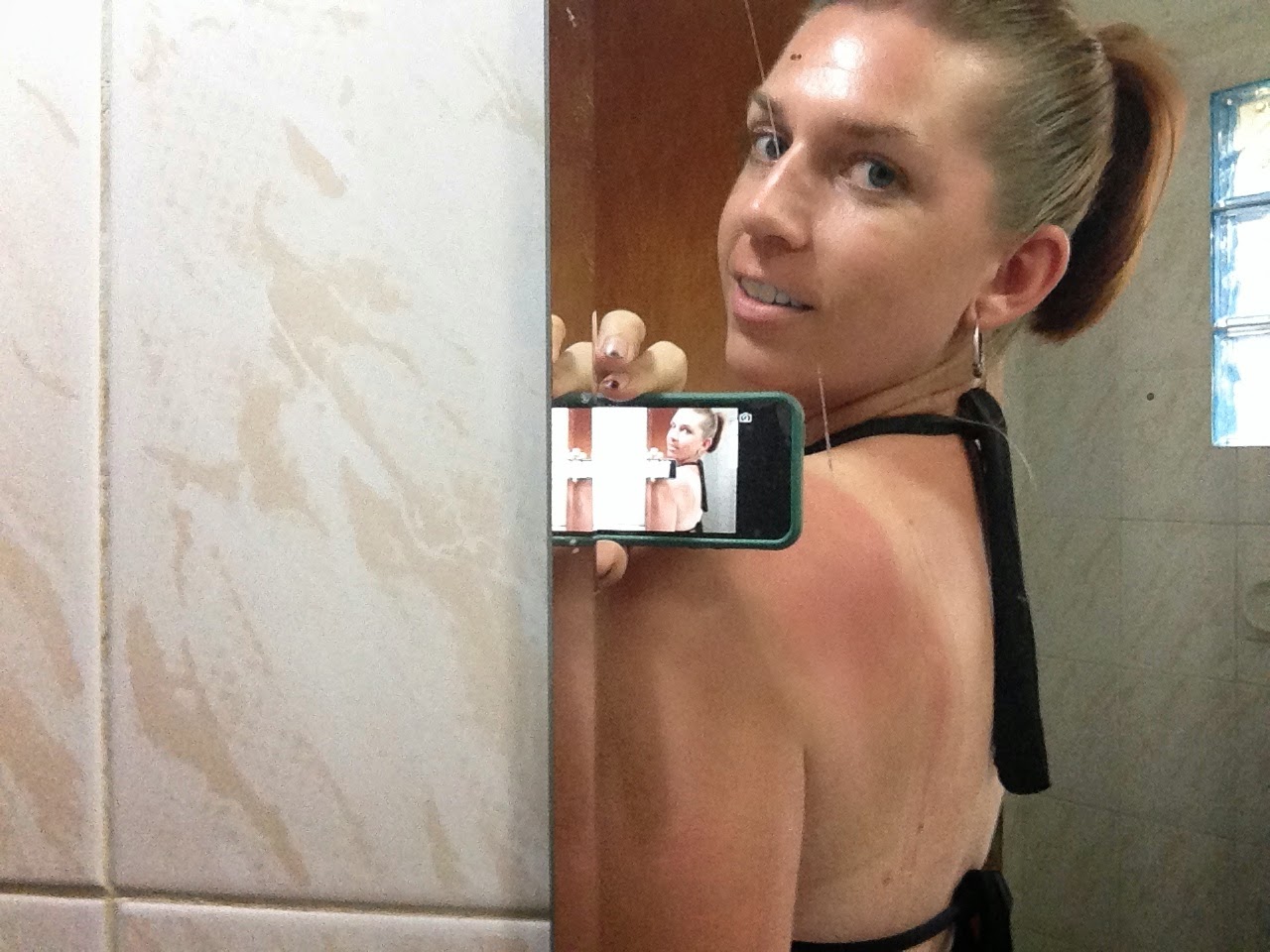
A horrible and humiliating bathroom mirror selfie
 that I contorted myself to take that Judy, Megan, and Joanna
can laugh at for years, but I wanted to show you my multi-colored skin.
That is not a shadow from my phone on my shoulder, by the way.
I really do have a very crispy brown shoulder line that looks like I didn't
scrub off well, but I did. And then I'm red because I forgot to put on
sunscreen today when I went to go see the hippos. And then my natural whiteness
is there because I wear shirts in public, except for now I'm at the beach so--swimsuit.


So you don't leave the blog with that image of
my impending skin cancer burned into your brain,
here's me with Repent's niece (I forgot her name!), Gadi and Ruben--
since last post I didn't get to put in a good photo of him.
Can you see the mischief brewing in Ruben's eyes?
Oh, he is up to something.